
Dryads
The different species and sub-species of sentient beings in Felarya. From giants to tinies, and preys to predators. From the ingenious Humans, to the reclusive Majuras, the noble Sphinxes, the mysterious Nemesises, the peaceful Gerridis or the fierce Crimson Maidens.
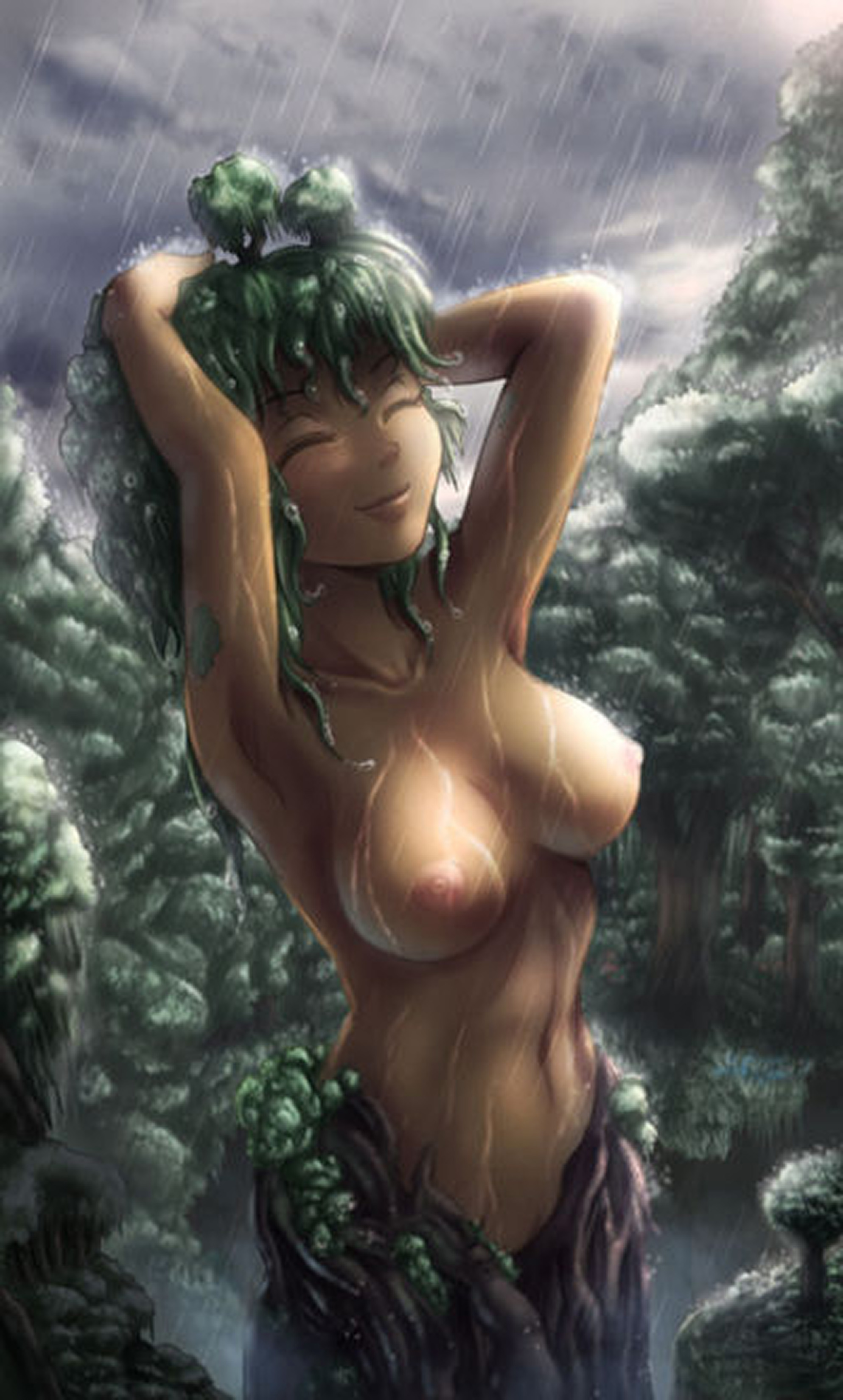
Dryads are half plant, half women creatures found in many places across Felarya. Their size varies a lot, but Dryads can easily grow over 130 feet tall and, in the deep, unexplored regions of Felarya, some are rumored to reach humongous heights. It's hard to characterize dryads, as their appearance varies quite a lot between specimens. They have a trunk in place of their legs, so they spend most of their time rooted in one spot. Unlike most other rooted "plants" though, dryads can control their roots' movements to some extent, allowing them to uproot and slowly move around if necessary. It is a slow process, but in the span of a few days, it's not impossible for them to have completely disappeared from their original spot, finding themselves hidden elsewhere in the vicinity.
Dryads share a sort of spiritual link amongst themselves, which means that they can communicate at a distance, share sensations (sight, smell, hearing, and taste), and be informed on the many things that happen in the forest. A dryad can also shut down this link if she wishes for some true alone time. Once in her long life, a dryad can share a version of this link with another being, regardless of that person's race. This special link connects that person to that dryad alone, and not to the greater dryad network.
Hunting Habits
In spite of their immobility, dryads pose a serious threat to adventurers. They are mostly carnivorous, and their arms are incredibly strong, enough so that they can crack a vehicle in half as easily as we can crack a nut. Despite their apparent bulkiness, many dryads are limber and flexible, which makes their capture range a lot larger than it looks like at first glance, and many use vines and roots to catch prey or defend themselves. They are also experts at mimicry and transformation, sometimes using magical illusions to improve it. Using her transformation abilities, a dryad can shape and mold her body to a certain extent, looking a lot more like a regular tree and hiding her more human features, turning them into solid bark. Even if you *know* that is a dryad there, if she wishes to remain hidden you will have a hard time distinguishing her from the background.
Their nature tends to lead them to be rather passive, almost constantly in a sleeping or drowsy state. Because of that passivity, lots of dryads will not actively hunt for prey, and will simply wait instead, either lying down, or standing close to a cliff or branch with their mouth wide open, their camouflage making it appear just like a regular tree, with a convenient opening to hide in. When prey enters the mouth, and applies a certain amount of pressure to the tongue, it triggers an automatic swallowing reflex that doesn't require the dryad to be actually awake.
Moreover, many dryads have a nectar-like saliva with a sweet and enticing smell designed to attract specific types of prey. The type of prey it's meant to lure largely depends on the species and location of the dryad. While the saliva of Faebanes posseses a sent that attract fairies, others dryads use it mostly only for animals. Humanoids, for their parts, seem largely unaffected besides finding the smell sweet. It is worth noting that, in some rarer cases, some dryads can impart special properties to their saliva, such as making it numb whatever it touches, heal injuries, or induce sleepiness.
Digestive System
The digestive system of a dryad is different than that of a human. Their stomach shares some similarities with a pitcher-plant, looking like a large pouch of varied shapes and they lack intestines. Their stomach is not as active as a human stomach either, churning slowly and secreting less gastric juice once food has entered it. Instead, the organ always has a pool of acid ready at the bottom. The walls of the stomach are covered by small tendrils that absorb digested food like an intestine would. The stomach acids of a dryad are strong and can dissolve bones, although they break down food more slowly than other species. If a human were to be swallowed by a dryad and somehow be able to see in the dark, it wouldn't be uncommon to see the half-digested remains of past prey lying in the bottom. Indigestible substances like metal are eventually regurgitated by the dryad. This also means that dryads can regurgitate almost anything they swallowed at will.
The stomach of a dryad is even more unlike any of other species in that it's a small ecosystem of its own. There are fungi growing on the walls and various creatures, symbiotes and parasites, manage to live in that dark, humid and sweltering organic environment. Dryads possess a strong control over their esophagus and can easily keep their throats open, allowing both prey and small critters to enter inside their digestive system, without them having to pay attention. Certain of those small critters are given free passage by the dryad; being allowed to go in and out and to seek refuge inside of her stomach, in exchange of small services such as cleaning and removing parasites. Some of those critters are pretty clever and have been even known to steal things from adventurers before rushing into the dryad's throat for safety, luring the furious and unwary prey literally inside her mouth and gullet, thus greatly facilitating her hunt.
In some rare cases, a human swallowed down by a dryad could find themselves sharing the stomach with a very unpleasant occupants: a gut worm and find themselves swallowed alive a second time by the large parasite.
Dryads are not as voracious as some other predators though, and can, to some extent, rely on photosynthesis to feed. They are usually sweet, pleasant, and wise beings; they get along very well with the other races (those who are not prey, that is). This is especially true with fairies, nagas, and deerataurs. Many dryads share a common weakness: fire. Once they start burning they are hard to put out, and so they are very afraid of it. Most dryads will completely hide from a fire-based or fire-using threat, or some of them, such as Drayla, have developed water magic as a defense against it.
Reproduction
Dryads possess a rather unique means of reproduction, combining seeds with other plants' pollen, captured from the air around them, before releasing the seeds when the conditions are right. They release a great many seeds, but only a few land somewhere that matches the criteria for the seed to sprout and begin the process of developing a young Dryad. Other seeds simply sprout regular plants. This explains why dryads appear to be so varied and with an appearance based on plants that grow in their region. At the first stage of their life, young Dryads appear to be just like normal plants, until they reach a certain size. At this point their outer casing will fall off, revealing their human half. Their now conscious minds connects to the Dryad network, where the other Dryads will take care of them, teaching and comforting them, and sometimes sending friends to help them if they need it. Young Dryads have an abundance of photosynthetic cells, allowing them to survive solely off light and water until they grow larger. As a Dryad grows, the amount of photosynthetic cells does not increase proportionately, which necessitates the introduction of prey into their diet to compensate. Young Dryads possess an unconscious camouflage and illusion reflex that immediately allows them to hide from would-be threats and predators. There is usually not more than a few dozens seconds between the time when the dryad reveals herself to the world for the first time, and the time she becomes hidden again.
Bramble Dryads
This species of dryad has dark brown skin (or red if they live in the jungle of perils), and hair of the same color, often decorated by small flowers or berries. Their tree part is covered by thorns, as is their human part, though to a much lesser extent. Each thorn is coated by a powerful liquid sleeping agent that can knock out a kensha beast in mere minutes. Although their thorns make them very dangerous to give surprise hugs to, a bramble dryad can retract their thorns instantly, and they usually do so when their friends are around. To do so indicates that the dryad both trusts and respects you. They are extremely dangerous to adventurers, being able to use their roots as weapons, ripping them from the ground with great speed and even at a distance from the dryad. These roots have more than enough strength to crack a vehicle in two, and enough precision to flick a cigarette out of your mouth without touching your face. This precision comes in handy when catching running prey. Bramble dryads share the same mental network as other dryads but tend to not use it very much, being more solitary and secretive than other species.
Shadow Dryads
These dryads lives in very dark places such as Evernight forest. Their skin is dark blue or black and their eyes are a beautiful glowing purple. They have small patches of soft lights on their body which create beautiful patterns, which they can control. The popular belief that shadow dryads have dark, evil personalities because they live in perpetual darkness is entirely false. Like most inhabitants of that zone, shadow dryads possess perfect night vision and so what they see is not a perpetual night but rather a normal forest, full of life and activity. Thus, shadow dryads have no more sinister personalities than the rest of their kin. This is little known among regular dryads because the regular network that most dryads use does not reach their shadow counterparts, who developed their own network. Shadow dryads are roughly as dangerous as other dryads, except that their mouths and throats are stretchier, allowing them to swallow muc
Faebanes
These dryads lives in very dark places such as Evernight forest. Their skin is dark blue or black and their eyes are a beautiful glowing purple. They have small patches of soft lights on their body which create beautiful patterns, which they can control. The popular belief that shadow dryads have dark, evil personalities because they live in perpetual darkness is entirely false. Like most inhabitants of that zone, shadow dryads possess perfect night vision and so what they see is not a perpetual night but rather a normal forest, full of life and activity. Thus, shadow dryads have no more sinister personalities than the rest of their kin. This is little known among regular dryads because the regular network that most dryads use does not reach their shadow counterparts, who developed their own network. Shadow dryads are roughly as dangerous as other dryads, except that their mouths and throats are stretchier, allowing them to swallow much larger prey than normal.
Swamp Dryads
These dryads are usually much taller than their land based counterparts, with a light brown or orange skin. They can blow a cloud of incapacitating spores which fogs the vision of their foes and makes them cough uncontrollably. Some swamp dryads have sharp leaves on their heads which can be thrown like razor blades. In the Ixtapal marshes they are particularly hard to spot because the human part is very high above the ground and is often lost in the fog that covers the swamps. Only the occasional loud noises from their stomach will give them away. While an unlucky adventurer might not be able to see the dryad through the fog, they posses piercing eyesight that allows them to see through smoke or fog without any problems. Unlike most other dryads, swamps dryads seem to be able to develop multiple links with others beings. They tend to build themselves a huge personal network with neighboring creatures, like harpies and saurotaurans,becoming the center of a little eco-system.
Mycodryads
Like one would figure, cactus dryads are found in desert zones and wastelands, mostly in the Akaptor desert. They are rare and rather small compared to most dryads, usually reaching heights of 80 to 90 feet, due to the lack of water. Their plant half is that of a giant cactus, ranging from light green to dark green or brown in color. They can store vast amounts of nutrients and water, for very long periods of time, in their lower halves. Their human part is usually a dark tan color and is covered in a thick carpet of cactus needles, thicker than a bramble dryad's thorns. Like bramble dryads, cactus dryads can retract these spines in the presence of friends, but can also launch them towards an enemy or attacker at great speed. For some reason, the time magic of the Akaptor desert is weaker around a cactus dryad, and some mages have theorized that the dryads are able to drain it to a certain extent. Cactus dryads are extremely voracious because of the lack of food and water in the desert, and will rarely let prey escape. They hunt by creating very realistic mirages and unless you are familiar with the zone and know that there is no oasis there, it is highly probable that you will be fooled by the illusion. There are exceptions though, and Akaptor nomads are said to have managed to befriend some of these dryads.
Alguanes
Alguanes are essentially aquatic dryads, part algae and part humans. They have usually long, slender bodies, slightly waving in the current, thin limbs, and mildly elongated faces, giving them an exotic look. Their skins appears to be rough and heavily textured as well, making it easy for them to blend into their surroundings without using any magic. The magic they are adept at is more centered on manipulating and changing the current of the water in a zone around them, which they use to capture prey. They can also create brief but powerful whirlpools on the surface by inhaling water, posing a threat to small ships sailing above them.
Snow Dryads
Snow dryads live mainly on snowy mountains and plateaus. Their trunks and skin are white, they have evergreen foliage, and are generally smaller than most dryads, growing to between 70 and 100 feet tall. However, they make up for their short height with their powerful lungs. They use them mostly to suck in prey from a distance, but can also blow an enemy right off an edge, or even freeze them. They are obviously very resistant to any cold-based magic and some of them master a powerful blizzard spell that works very well when combined with their powerful air blasts. Snow dryads mostly feed on animals, but will eat humans at the first chance they get, seeing them as a all too rare and sweet delicacy. Very few people ever manage to talk to a snow dryad, as it's usually impossible to even approach one without being vacuumed up and swallowed.
Domesticated Dryads
Domesticated dryads are a bit of a rarity on Felarya, in no small part due to the difficulty in acquiring one. Through magic, selective breeding, or nutrient deprivation, they are rarely capable of growing taller than an average human, though some mutant breeds are able to top the thirty foot mark, and they are all of the "lacking legs" variety. Being unusually small in stature these dryads are also rather limited as to what creatures they can eat, which results in them being much less voracious than their giantess counterparts. They rely entirely on an owner to both provide them with food and protect them. More often than not, the smaller dryads will be denied a link to the dryad network by being placed in potted soil until their loyalty and subservience to their owner is established. Domesticated dryads are often "content" with their life at this point, not recognizing that they are not free and might have had any other type of lifestyle. This is why the owner must be careful before planting a domesticated dryad, especially if she bears any magical talent. Once in contact with the soil of Felarya, she will comes in contact with the rest of her kin, and her loyalties may shift. Hence why owners will often "spoil" a dryad before the planting stage, to reduce the chances of her revolting at a later time. The relationship between a domesticated dryad and her owner is never a sure thing. Dryads are extremely patient beings and some loathe their "masters", secretly plotting against them while displaying an obedient and docile attitude. Some however, are totally loyal, seeing their owner as a sort of father or mother figure. This depends largely on how the dryad is treated and the environment she grows in. There is at least one instance of an arrogant noble being eaten by his pet dryad, and several other mysterious disappearances within expansive gardens can be linked to such a fate.
The diet of a domesticated Dryad is limited only by both what the owner can possibly feed her and what they choose to feed her. Some of the smallest sizes are sustained solely via photosynthesis and soil nutrients, while others are fed gourmet meals fit for royalty. Living food such as neeras is sometimes given to a domestic dryad, albeit rarely in large quantities lest she develops a taste for things still moving. Still, considering how expensive it is to buy a dryad, and amount of time necessary for them to develop, some nobles may "look the other way" if a gardener or three go missing every now and then. After all, commoners are cheap, domestic dryads are not; one could buy a row of houses in Negav for a comparable cost! Rarely will one be owned by anyone other than a breeder or a noble. A domestic dryad's functionality is not limited to simply garden decor or display. If loyal enough, she can provide her owner with extraordinary pieces of information that only a dryad can acquire without the risk of approaching a wild counterpart. They are sometimes used as spies or for intelligence-gathering. Furthermore, few people will be willing to risk sneaking through a garden known to host such a being. While the owner may insist the creature to be safe, people will always remain cautious on Felarya of something that can eat them or has connections with another being who could.