
Centaur
The different species and sub-species of sentient beings in Felarya. From giants to tinies, and preys to predators. From the ingenious Humans, to the reclusive Majuras, the noble Sphinxes, the mysterious Nemesises, the peaceful Gerridis or the fierce Crimson Maidens.
Centaurs are half human, half horse people. They are not very numerous on Felarya but they are concentrated in some places such as the great rocky fields and the Moyuk hills. Several species of centaurs exist, most of them giants, and most are somewhere between 90 and 130 feet tall. Felaryan centaurs are fearsome creatures. They have a voracious appetite and often attack caravans of travelers. Their speed makes any escape almost impossible: most vehicles are easily outrun and centaurs can feel the faintest vibrations of the ground, allowing them to locate prey miles away. The sight of a giant centaur galloping at full speed is a spectacle you never forget and the tremors they produce when their hooves hit the ground are absolutely terrifying. When hunting, centaurs either catch prey with their hands, or simply lean forward, mouth wide open to gobble up victims on the ground, tongue licking the ground behind them, pretty much in the same way horses might graze in a field. Unlike most other hybrid creatures in Felarya, centaurs have their stomach situated in their animal part, which means it's huge. It would take dozens of humans to fill it, although centaurs will eat just about any creature small enough to be swallowed. When digesting a meal, a centaur will fall asleep, usually for a whole day. Some centaurs master a powerful shamanic elemental magic but they are thankfully rare.
Minimal: A totally harmless being such as a mouse or a rabbit.
Very Low: Mostly herbivores but who can still strike back if attacked.
Low: Various animals such as felines.
Moderate: A moderately dangerous Felaryan creature can still be very dangerous in another world. For example a great white shark would rank between Low and Moderate
Medium: A predatory, dangerous and often man-eating creature.
High: A great predator. Crisis is in this category.
Very High: A top predator. This creature could take on a small army.
Critical: In Felaryan scales, very few creatures reach this rank.
Extreme: A guardian or a mythical creature. Only a god can hope to survive a confrontation with one of these.
Deerataur
Size:
Threat:
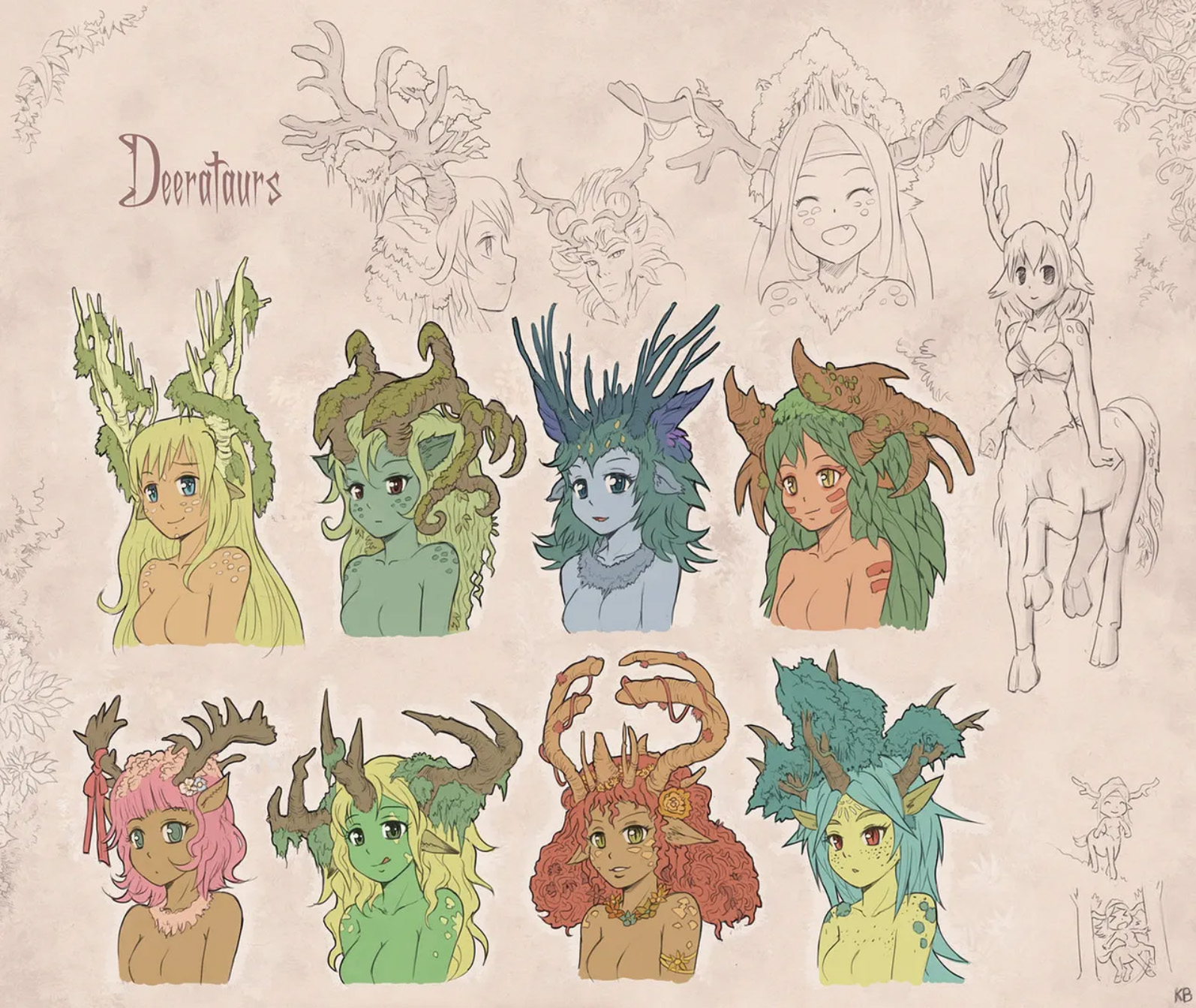
Deerataurs are a rare species of centaurs found mostly in the misty glade and other magic rich zones. They are essentially centaurs with huge leafy antlers and brown or greenish skin. They are very close to nature and plants, not unlike unlike dryads and posses a strong weather-based magic. They can bring storms with them, leave a thick fog in their wake or make rain fall which makes them very appreciated by plants in general. They also possess the ability to draw the ambient magic radiating from the soil in order to accelerate by tenfolds the growth of plants there. A single Deerataur could plant a whole forest in a matter of weeks if the area is magic-rich enough. Deerataurs usually get along very well with dryads and are often linked to them.
Deerataurs are less voracious than centaurs, as their horn use a sort of photosynthesis which reduces their need to feed in the normal sense of the word. However, just because they need to eat less doesn't make them any safer to be around. Deerataurs are known to be very wild creatures, hostile to whoever they see as intruders and will most likely attack and devour any adventurers they find given the chance. Their special stomach can drain magic, and their digestion is magically enhanced, making the process a lot faster and less disabling for them than it is for normal centaurs.
Zebra Centaur
Size:
Threat:
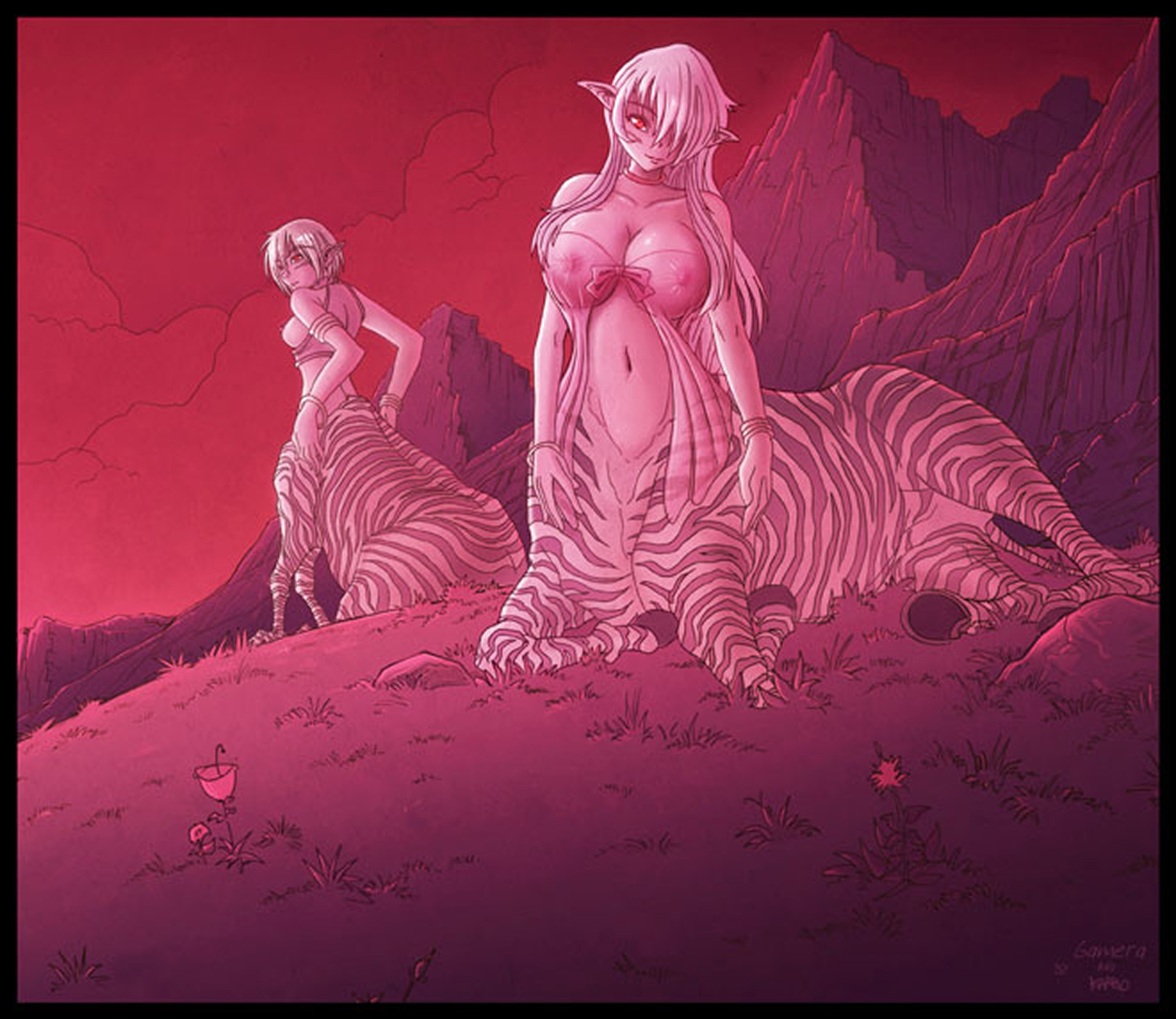
This particular race of centaurs is more refined than their primitive counterparts. They sometimes wear clothing and are generally more agile and proficient with ranged weapons. They are also smaller, between 80 and 100 feet tall. Perhaps the strangest thing about zebra centaurs is their double personality. During the day they are pleasant creatures, rather friendly to humans (though this doesn't mean they won't gobble one up from time to time) and they sometimes escort caravans for a while just for the sake of chatting and exchanging news. However, when the sun sets their eyes begin to glow red and a aura of fear surrounds them. The nonchalant centaur then turns into a fearsome and hungry predator.
Cheprys
Size:
Threat:
Sometimes thought to be a legend even among Felaryan predators, Cheprys are a rare species of giant tauric beings with the lower body and horns of a goat and typically pale hair. They can be found in high attitude mountainous regions in the north of Felarya. There are persistent mentions of Cheprys adorned with wings but if they do indeed exist, they are even rarer. It could be a mistake due to the extraordinary natural agility of these beings and their strange gravity-defying magic that can almost make them look like they're flying. Indeed, the most remarkable trait of Cheprys is their ability to stand on any surface at almost any angle and in some cases even ignore gravity all together without uttering any spell. Their hooves do seem to briefly emit a shimmering band of light as they move from surface to surface while executing these impossible feats. They also possess tremendous power in their hind legs despite their light frame, allowing them to go airborne in seconds and landing with perfect control and grace. It makes them terrifying predator, able to chase their prey to seemingly anywhere. fortunately though, Cheprys aren’t the most focused predators, playfully going after a prey with excitement in their eyes one moment, only to turn around and decide it’s not worth their effort the next.
Cheprys are a tribal species often forming small but tight-knitted packs that can quickly band together to face a common threat. A rather introverted lot, they tend to interact little with others species, clearly preferring the company of their own kind. Despite being comfortably high in the food chain, Cheprys seem to be always on the lookout, carefully scanning their environment for any anomaly or potential danger. They only let their guard down when they are with their clan, where they turn to joyous companions, sharing stories, hunting tips, drink and food. They are nomadic in nature, not liking to stay too long in the same spot and they are deeply attracted by the unknown. Cheprys do not build permanent structures to live in, often preferring to camp under the light of the stars or in small caves if the weather get tough, although their body possess a natural resistance to cold temperatures.
Another remarkable trait of the Cheprys is their proficiency at using bows. While they don't posses the uncanny talent of Elves or nemesises for reaching far away targets with pinpoint precision, Cheprys are particularly skilled at firing while moving, sometimes in the middle of a leap. Their small, compact bows compliment well that skill. They typically don't shot for great distance but they are sturdy and deliver fast-travelling projectiles. They can appear crude at first, made of wood, vines or leather, but they are remarkably well weighted.
A Cheprys will quickly use it at anything deemed to be a threat or for hunting. When it comes to human-sized prey, Cheprys will typically turn to special arrows delivering soft balls of a kind of living, sticky organic mold that will ensnare and enclose upon prey, disabling the prey without any damage and allowing the Cheprys to either savor and eat them on the spot along with the mold, not unlike a living gumdrop, or to store them in a pouch for a late snack. The digestive tract of a Cheprys is ruminant based so if you have the misfortune of being swallowed by one, digestion can take quite a long time as you may find yourself brought back up to the mouth for a second or third round of a saliva bath before the Cheprys body decides your ready enter the next stage of digestion, deeper in its four compartmented stomach.